Reference
How it works
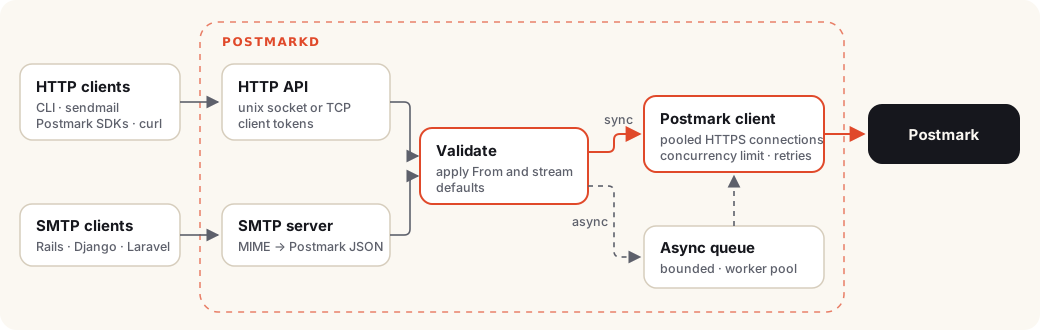
postmarkd is a single Go program with no third-party dependencies. This page follows a message through it and explains the design decisions that matter when you run it.
#Overview
| Component | Package | Responsibility |
|---|---|---|
| HTTP API | internal/server |
Postmark-compatible endpoints, auth, validation, defaults, async dispatch, health and metrics |
| SMTP server | internal/smtpd |
A minimal ESMTP server (PIPELINING, SIZE, 8BITMIME, AUTH) |
| MIME converter | internal/rfc822 |
Raw messages → Postmark JSON, for SMTP and sendmail |
| Postmark client | internal/postmark |
Connection pooling, the concurrency limit, retries |
| Queue | internal/queue |
Bounded in-memory queue and worker pool for async sends |
| Blackhole | internal/blackhole |
A stand-in for Postmark in blackhole mode |
| systemd | internal/systemd |
Socket activation, readiness, watchdog |
| Metrics | internal/metrics |
Lock-free counters and Prometheus output |
#The life of a message
#1. Arrival
A message arrives over one of four paths:
- HTTP, on a unix socket or TCP port, at a Postmark-compatible endpoint.
- SMTP. The SMTP server collects the envelope and data, and the MIME converter turns the message into Postmark JSON.
- sendmail. The
sendmailcommand converts the message on the client side and posts it over HTTP. - CLI.
postmarkd sendbuilds the JSON and posts it over HTTP.
Everything after this point is shared.
#2. Authentication
If POSTMARKD_AUTH_TOKENS is set, the request must carry one of the tokens,
compared in constant time. SMTP clients authenticate with AUTH PLAIN or
AUTH LOGIN, except on unix sockets, where file permissions already control
access.
#3. Validation and defaults
postmarkd reads each message once, looking only at the fields it checks:
From, To/Cc/Bcc, HtmlBody/TextBody, TemplateId/TemplateAlias
and MessageStream. It doesn't copy them. If the message has no From or
stream, the configured default is inserted. Otherwise the original bytes
are forwarded untouched, so fields postmarkd doesn't know about, including
ones Postmark adds in the future, reach Postmark unchanged.
Messages with no sender, no recipient, no body (or template), or batches
that are empty or larger than 500 are rejected with a Postmark-style 422
before any network call. This matters most for async sends, whose callers
would otherwise never see the error.
#4. Synchronous or async
Synchronous (the default): the request waits for Postmark and returns
Postmark's response unchanged, so callers see real MessageIDs and errors.
Async (?async=true or X-Postmarkd-Async: true): the prepared request
is placed on a bounded in-memory queue and the caller gets 202 Accepted
immediately. POSTMARKD_WORKERS goroutines deliver queued requests. When the
queue is full the caller gets 503 with Retry-After. That back-pressure
keeps memory bounded under any load.
#5. Sending to Postmark
All sends share one HTTP client with keep-alive connections to
api.postmarkapp.com (HTTP/2 when available). A semaphore caps in-flight
requests at POSTMARKD_MAX_CONCURRENCY; requests beyond that wait for a slot
instead of failing. This is both the throughput knob and the protection
against overwhelming Postmark.
#6. Retries
postmarkd retries only when Postmark cannot have accepted the message:
| Failure | Retried? | Why |
|---|---|---|
| DNS failure, connection refused, dial timeout | Yes | The request never left the host. |
429 Too Many Requests |
Yes, honouring Retry-After |
Postmark refused it. |
502, 503 |
Yes | A proxy or maintenance page answered, not Postmark's API. |
500, timeouts after sending |
No | The message may already be sent. |
4xx validation errors |
No | Retrying won't help. |
Backoff is exponential with jitter (about 250 ms, 500 ms, 1 s, … capped at
10 s), up to POSTMARKD_MAX_RETRIES times. Duplicate mail is worse than a
reported failure, so ambiguous failures go back to the caller.
#7. The response
HTTP callers get Postmark's status and body unchanged. SMTP clients get 250
when Postmark accepted the message, 451 (try again later) when Postmark was
unreachable or rate limiting, and 554 when it rejected the message. The
sendmail command exits with the matching sysexits.h code.
Every outcome is counted in metrics and failures are logged with the request
ID, which callers can supply in X-Request-Id.
#Lifecycle
Startup. postmarkd loads and validates configuration (defaults, then the
config file, then the environment), takes listening sockets from systemd if
it was socket activated or binds its own, then reports READY=1 to systemd
and starts the watchdog.
Shutdown. On SIGTERM or SIGINT it reports STOPPING=1, flips
/readyz to 503, stops accepting connections, lets in-flight HTTP and SMTP
requests finish, and drains the async queue, all within
POSTMARKD_SHUTDOWN_TIMEOUT. Queued requests still undelivered when the time
runs out are logged and counted as dropped.
#Design choices
- No dependencies. Only the Go standard library, so the binary is small, static and easy to audit.
- Postmark's API, not a new one. Existing knowledge, documentation and SDKs apply, and postmarkd forwards fields it doesn't know about.
- Never duplicate mail. Retries only when delivery provably didn't happen.
- Bounded everything. Request bodies, the queue, concurrency and timeouts all have limits, so overload turns into back-pressure, not memory growth.
- The token in one place. Applications never see the Postmark server token. systemd credentials keep it out of files and environment variables.
#Limits
- The async queue is in memory: a crash or
SIGKILLloses queued mail. Use synchronous sends when every message must be confirmed. - SMTP has no STARTTLS: use it on loopback, unix sockets or private networks.
- Up to 50 recipients per message and 500 messages per batch, as in Postmark.
See Benchmarks for how fast each stage is.