How it works
Two oscillators, one portable DSP core. The modulator shapes the primary through through-zero FM, a wavefolder and AM or ring mod, and three feedback paths let it misbehave. Everything runs 4× oversampled and is decimated with a 129-tap Kaiser FIR.
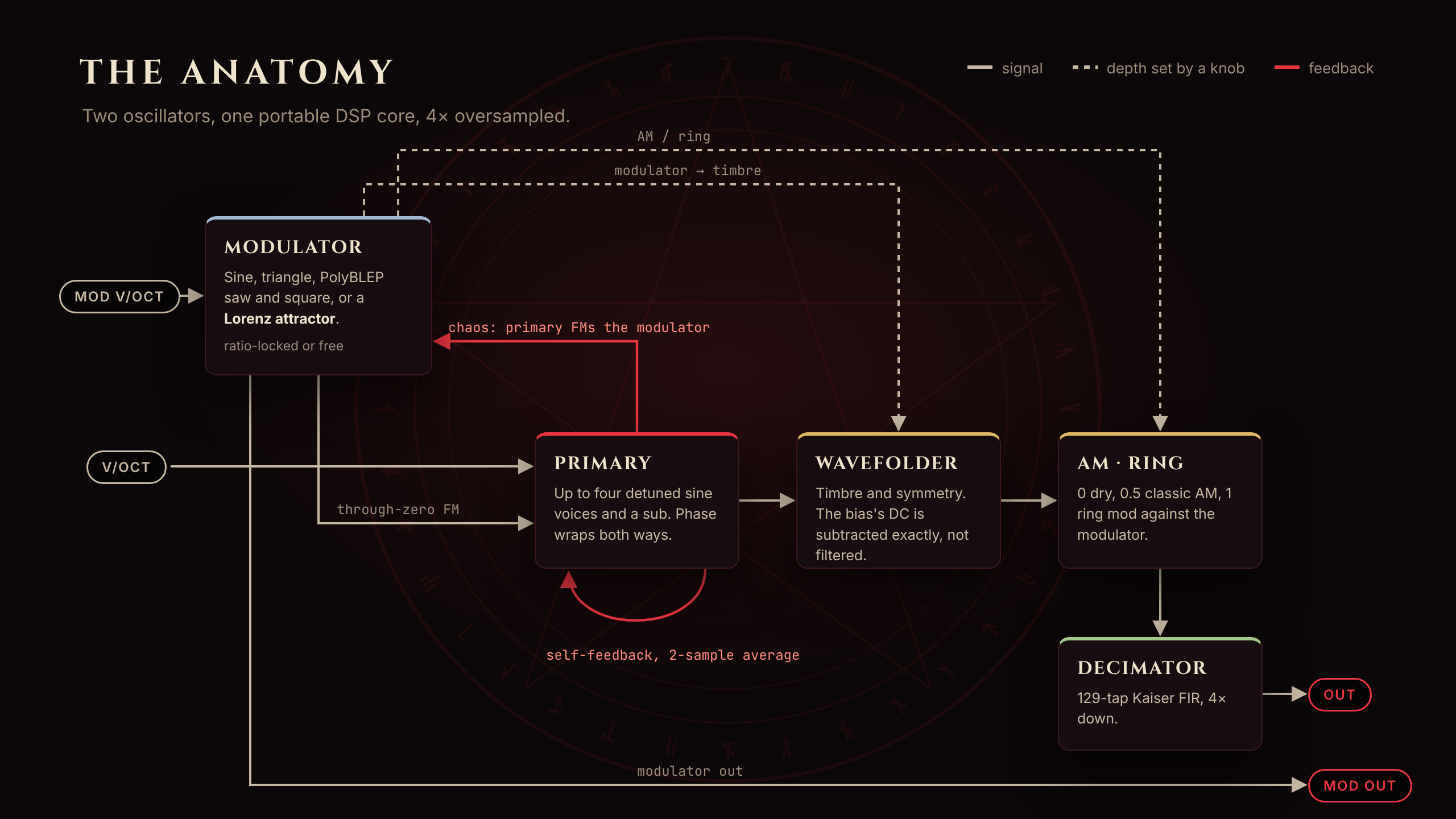
Layout
dsp/      portable engine: no heap, no platform headers, volts in / volts out
hw/       Electrosmith patch.Init() firmware (libDaisy)
vcv/      VCV Rack 2 plugin
test/     host tests, WAV renders, aliasing analysis
The firmware, the plugin and the host tests all include dsp/ unchanged, so what the tests measure is what the module plays.
Design notes
Wavefolder DC. Symmetry biases a sine folder, which creates DC. A high-pass alone re-centres the wave and pushes peaks to about ±8 V. Because the core is a sine, the DC is exactly sin(a·b)·J0(a), so it is subtracted analytically (a small J0 table), with no limiter and no added aliasing.
Through-zero FM. The primary phase increment is allowed to go negative. The phasor wraps in both directions.
Self-feedback is phase modulation by the primary's own output, averaged over the last two samples (the DX7 trick). Without the average, feedback "hunts" at Nyquist and turns to hiss far too early.
Chaos feeds the primary's output into the modulator's frequency, clamped to ±20 kHz so heavy settings can't push it far past the band limit.
Macros. FLESH, MALICE and LEGION are piecewise-linear curves in dsp/Macros.hpp, applied by dsp/Panel.hpp: the one mapping from panel to engine that the firmware, the VCV plugin and the patch renders share. MALICE brings in a little FM of its own because chaos only reaches the primary through FM; without it, MALICE alone would stop at a saw. Chaos is a tipping point, so its curve is stretched to put the edge across 0.55–0.8 of the knob instead of one 5% step.
Unison stacks up to four primary voices before the wavefolder, so the fold intermodulates them. Every voice gets the same through-zero FM and its own self-feedback history. An idle voice shadows voice 0, so it fades in exactly in phase and only spread or drift pull it away; with no spread, four voices sound like one. Detuned sines this close look like one sine with a beating amplitude A, so the folder's DC becomes sin(a·b)·J0(a·A), with A tracked per sample from the voices' phasors. Without that, the beat leaks through the DC blocker as a slow wobble (0.26 V against 0.05 V in the host tests). A sub one octave down adds its own J0 term.
Lorenz is integrated with a midpoint (RK2) step capped at 0.02, with a reset guard, so no setting can make it run away or produce NaN.
CPU. Cost is dominated by two 129-tap decimators. If the CPU meter says you need headroom, cascaded half-band filters are the next optimization.