python 3.10End of life
Python 3.10
Released 2021-10-04 · active support ended 2023-04-05
Security support ended 2026-10-01. The last patch is 3.10.22.product_get_cycle, read live from endoflife.date

rossedman/endoflife-mcp-server
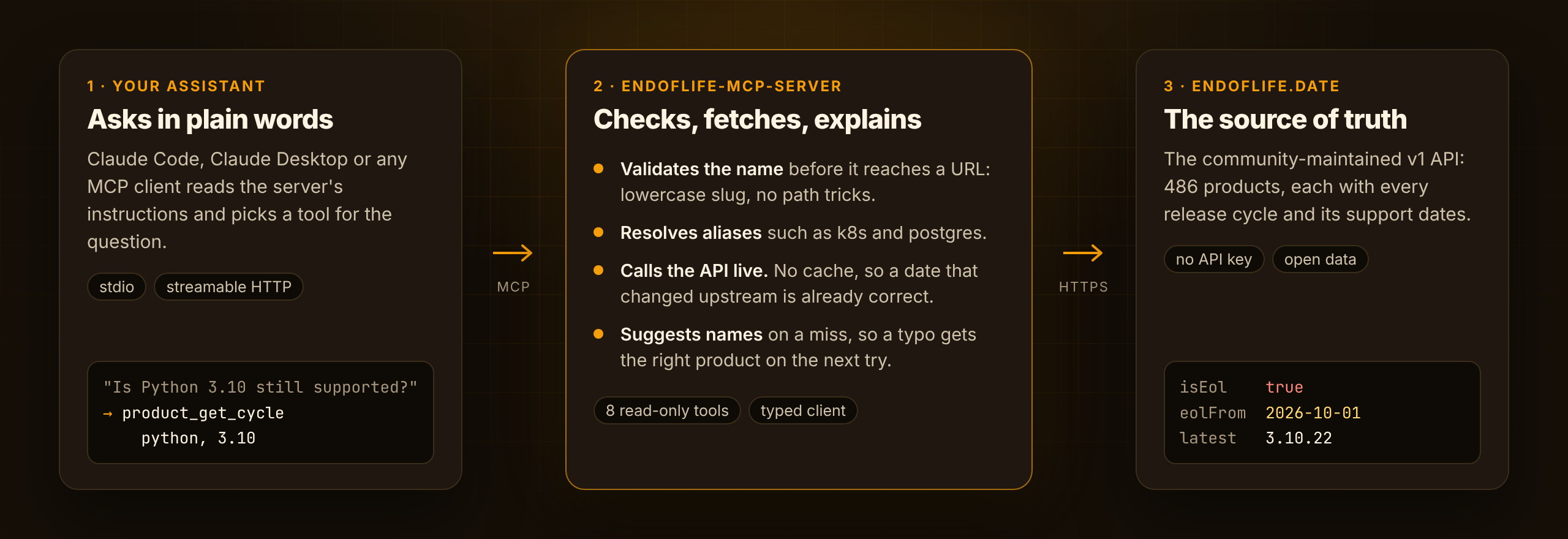
An MCP server that gives your AI assistant live support dates from endoflife.date. Get the date, not a guess.
uvx endoflife-mcp-server serve
The problem
Support dates move: a release gets extended, a cycle is cut short, a new one ships. A model answering from training data is months behind and sounds just as sure. This server lets it read the date from endoflife.date at the moment you ask.
Three ways to ask
Your assistant picks the tool that fits the question. Start narrow for a yes or no, go wide to plan an upgrade, and browse when you don't know the name.
The answer is two fields: whether support has ended, and when.
product_get_cycle python 3.10
→ isEol: true
eolFrom: 2026-10-01Every release cycle with its dates, newest first, ready to compare.
product_get_all kubernetes
→ 1.37  eol 2027-10-28
  1.36  eol 2027-06-28
1.35 eol 2027-02-28Browse by category or tag when you don't know the product's name.
category_list_products database
→ 27 products
  mariadb, mysql, postgresql,
  redis, valkey, ...
Why endoflife-mcp-server
Each call reads endoflife.date directly. There is no cache and no database, so a date that changed upstream is already correct here.
All 8 tools are annotated read-only. They query a public API and cannot change anything on your machine.
Ask for 'pyhton' and the error answers: Did you mean python, photon, iphone. The model retries without bothering you.
k8s, postgres and eks resolve to the products endoflife.date knows, and names are checked before they reach a URL.
stdio for Claude Code and Claude Desktop, or streamable HTTP at /mcp when a client connects over the network.
Six settings from flags, ENDOFLIFE_MCP_* variables or a TOML file, with a fixed order: command line, then environment, then file.
Quick start
You need uv, which fetches Python for you. Claude Desktop and other clients use a short JSON snippet instead.
Full getting-started guide$ claude mcp add -s user endoflife -- uvx endoflife-mcp-server serveIt should be listed as connected.
$ claude mcp listIn any Claude Code session, in plain words.
> Which Kubernetes versions are still supported?How it works
Documentation