How it works
Between your question and the answer there are three hops and one rule: nothing is remembered, so every answer is read from endoflife.date at the moment you ask.
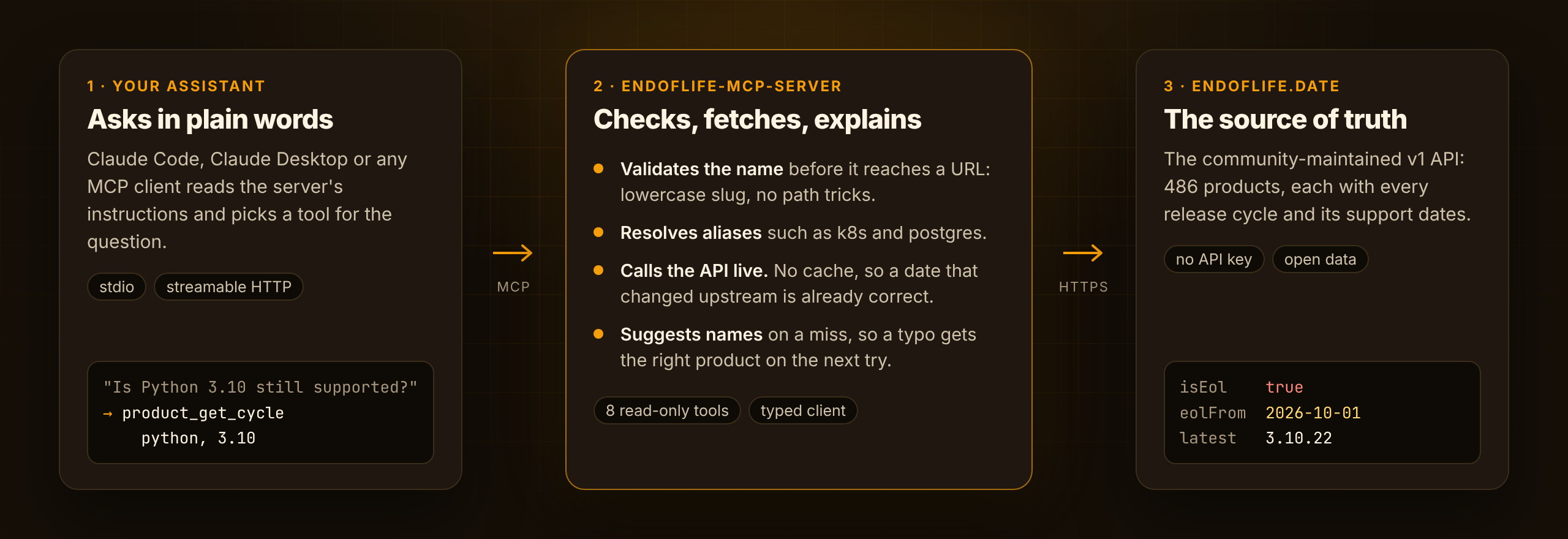
The three parts
Your assistant is any MCP client. When it connects, the server hands over a short set of instructions (start with product_get_all, names are slugs, dates are ISO 8601) and the list of eight tools, so the model knows how to ask.
The server is a thin layer, on purpose. It validates names, calls the API, and shapes the result. It has no database and no cache.
endoflife.date is the community-maintained source. The server uses its v1 API through a client generated from the vendored OpenAPI spec, so responses are typed rather than parsed by hand.
What the server adds
- Name checking. Names reach the model from anywhere, so each is trimmed, lowercased and matched against the characters real product names use before it is placed in a URL.
- Aliases.
k8sandpostgresresolve to the product the API knows. - Suggestions on a miss. A wrong product name returns the closest real ones in the error text, so the model corrects itself without asking you.
- Plain errors. Rate limits, timeouts and unexpected answers become short messages the model can relay, instead of stack traces.
- A polite user agent. Every request carries the server's name and version, so endoflife.date can see where traffic comes from.
What it does not do
It does not cache, so a burst of questions is a burst of requests. It does not scan your project for versions; your assistant does that, then asks this server what each version's dates are. And it does not write anywhere: every tool is read-only.