How it works
sminer is a linear batch pipeline. Each stage reads from and writes to one SQLite file, so you can re-run any stage on its own, and a repeat run does only the new work.
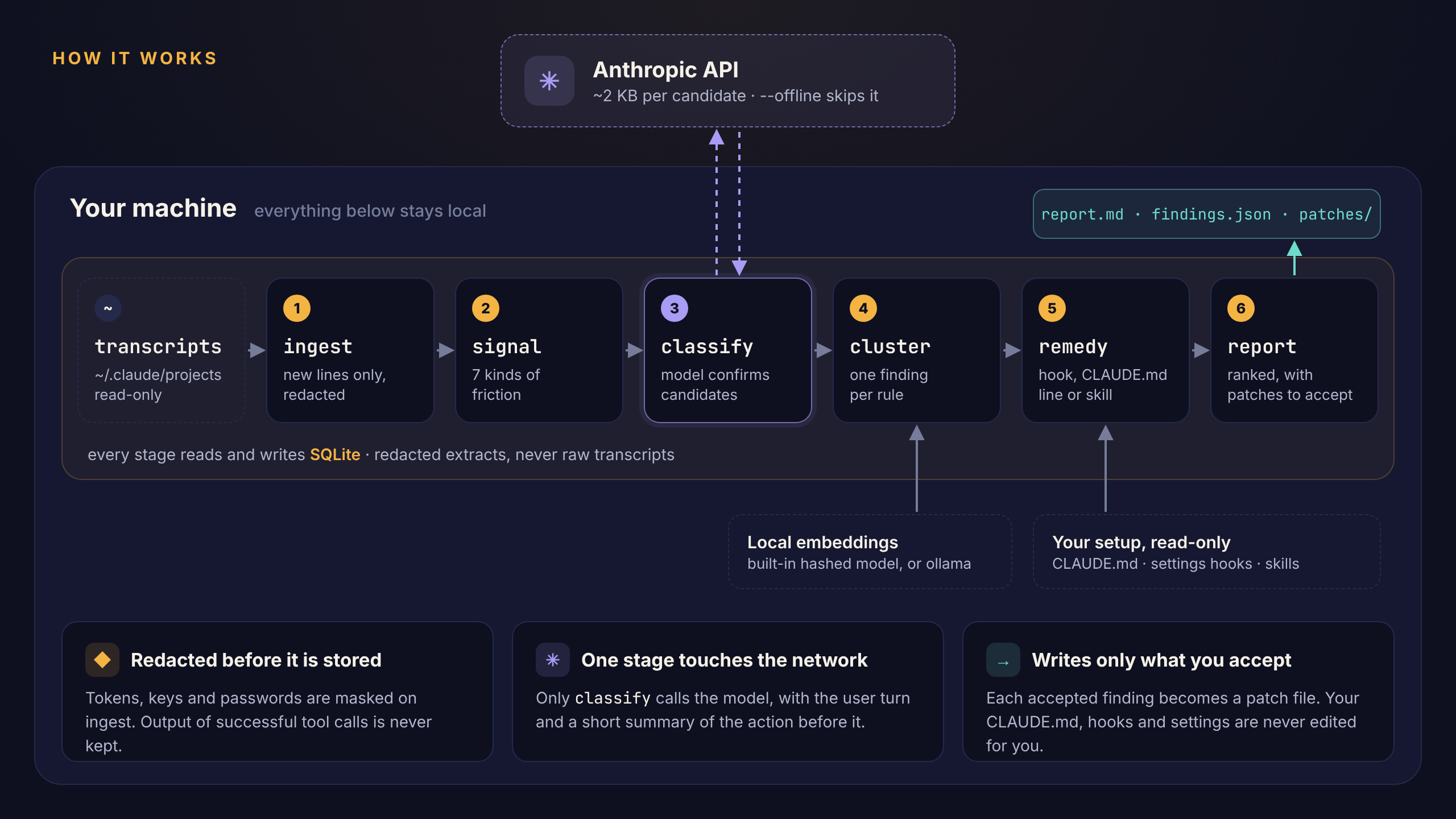
| Stage | Command | Reads | Writes |
|---|---|---|---|
| Ingest | sminer ingest |
~/.claude/projects/**/*.jsonl |
turns, sessions, files |
| Signal | sminer analyze |
turns | signals |
| Classify | sminer analyze |
candidate signals | verdicts and rules on signals |
| Cluster | sminer analyze |
signals | findings |
| Remedy | sminer analyze |
findings, your CLAUDE.md, hooks and skills | proposals on findings |
| Report | sminer report |
findings | Markdown, findings.json |
sminer run does all of them in order.
Ingest
Claude Code writes one JSONL file per session under ~/.claude/projects/<encoded-cwd>/<session-id>.jsonl, one event per line. The format is undocumented and changes between releases, so the parser is deliberately tolerant:
- Unknown fields are ignored.
- Message content can be a plain string (1.0.x) or a list of blocks (2.0.x).
- Unknown event types are counted and skipped. They appear in the report's Parser notes, so you notice when the format changes.
- A malformed line is skipped and counted. It never stops a run.
Ingest is incremental. For each file, sminer remembers the byte offset where it stopped and reads on from there next time. A last line that's still being written is left for the next run.
Before anything is stored, text is redacted and truncated. Output from successful tool calls is dropped entirely. Each stored turn points back to its file and byte offset rather than copying the transcript. See Privacy and safety.
Repositories are attributed by the session's working directory, resolved to its git root when that still exists on disk.
Signal
Seven detectors look for friction in each session that has new turns: corrections, interrupts, rewinds, repeated instructions, hook blocks, tool failure loops and manual fix-ups. Each emits a signal with a type, a weight and a redacted excerpt. Signals describes each one.
Signal IDs are derived from the turn they came from, so re-running detection never duplicates them, and classifier results attached to them survive.
Classify
Corrections, rewinds, interrupts with a typed explanation, and repeated instructions are candidates. The classifier (claude-haiku-5-5 by default) answers three questions about each one:
- Is it really a correction, or a standing convention worth writing down?
- What is the general rule behind it, as one imperative sentence?
- Which remedy fits it: a hook, a CLAUDE.md line, a skill, or nothing?
Each call sends the candidate message and a short summary of what the assistant had just done (tool name, path or command, a snippet), capped near 2 KB. Calls are capped per run (classifier.max_calls_per_run) and cached on the signal. If calls keep failing, for example with a bad key, sminer stops early and continues with heuristics alone.
Hook blocks, failure loops and fix-ups are deterministic and never sent.
Cluster
Signals are grouped into findings, one per underlying rule:
- Corrections, interrupts, rewinds and repeated instructions cluster on text similarity: the classifier's rule when there is one, otherwise the excerpt. Embeddings are always computed locally, by a built-in hashed bag-of-words model or by ollama when it's running.
- Hook blocks group by hook and script, failure loops by command (
go test), and fix-ups by file kind (*.go,go.mod).
Clusters below --min-count occurrences (3 by default) are dropped.
Findings keep a stable ID across runs: each new cluster is matched to an existing finding by centroid similarity, or by key for the exact-match families. That's what lets accept and dismiss survive re-analysis, and what makes trends possible.
Remedy
Each finding is routed to a hook, a CLAUDE.md line, a skill or nothing, then checked against what you already have. Findings and remedies covers the rules.
Report
The report ranks findings by occurrences × weight × repos. Weights are 3 for high-signal types (corrections, interrupts, repeated instructions), 2 for medium (rewinds, hook blocks, failure loops) and 1 for fix-ups. It also lists how often each existing hook fired (Guardrail activity), the ignored findings, and parser notes.
Storage
Everything lives in $XDG_DATA_HOME/sminer (by default ~/.local/share/sminer):
| Path | What |
|---|---|
sminer.db |
The SQLite database, created with mode 0600. Pure-Go driver, no cgo. |
patches/ |
Patches written by sminer finding accept. |
Deleting the directory resets sminer completely. The next run starts from scratch.