How it works
tfmetrics is a five-stage pipeline with one file format in the middle. Scanning turns repos into facts; aggregation turns facts into metrics. Neither stage runs Terraform.
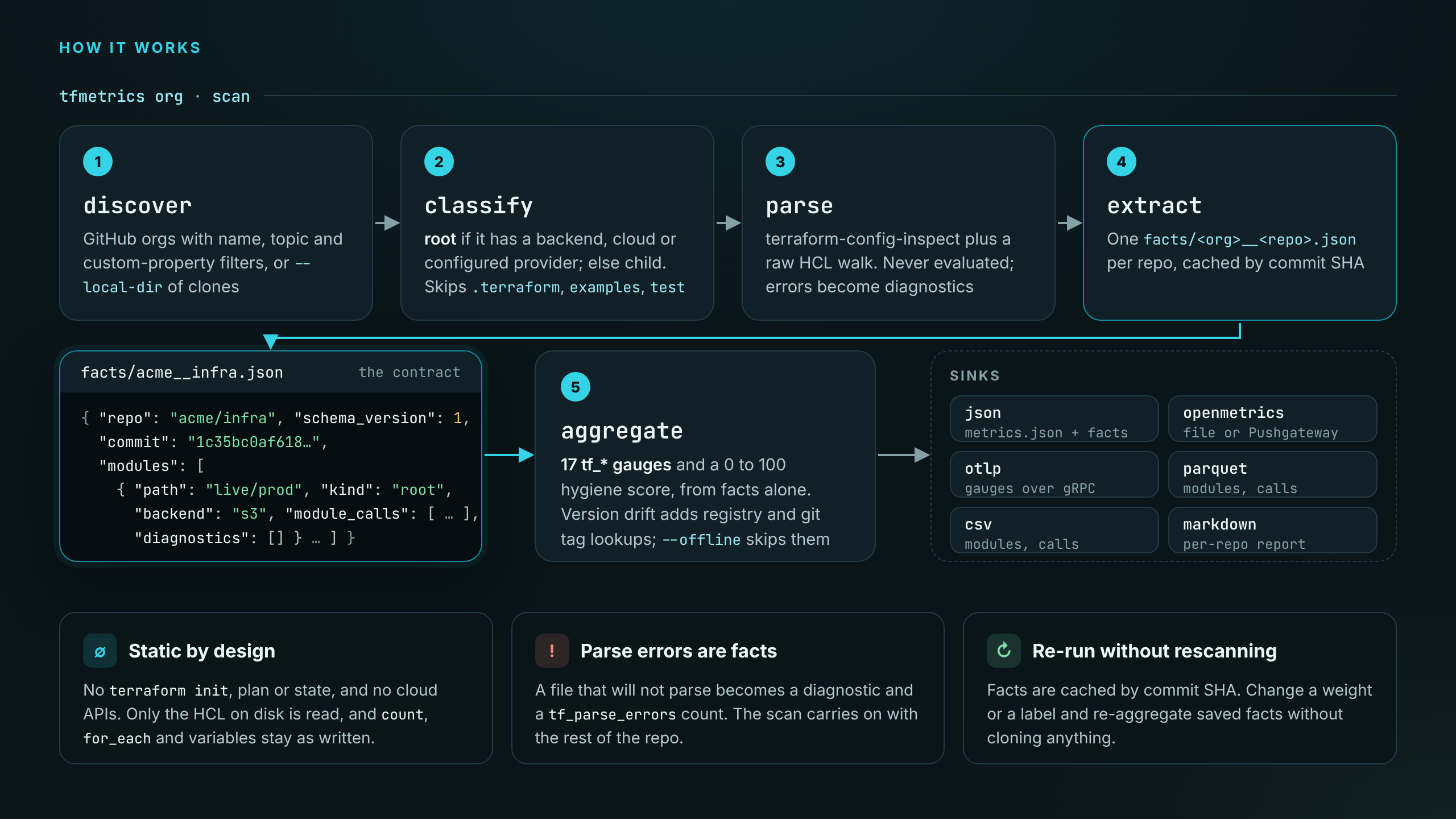
The five stages
1. Discover. tfmetrics org lists the repos of each configured GitHub org and applies that org's include and exclude filters on name, topic and custom property. Archived repos and forks are skipped by default. With --local-dir, it reads a directory of existing git clones instead and makes no API calls. tfmetrics scan skips discovery and takes paths, URLs or owner/name directly.
2. Classify. Each repo is cloned shallowly, with a sparse checkout of only *.tf, *.tf.json, *.tofu, *.tofu.json and CODEOWNERS. Every directory that holds Terraform files is a module. It is a root if it declares a backend or cloud block or configures a provider, or matches scan.root_overrides; otherwise it is a child. .terraform, examples, test, tests, testdata and hidden directories are skipped by default (scan.ignore_dirs).
3. Parse. Each module is loaded with HashiCorp's terraform-config-inspect library, then the raw HCL is walked for what that library does not expose: lifecycle settings, count and for_each, moved and import blocks, and whether a provider block is configured. Nothing is evaluated. A count = var.n is recorded as "uses count", and a variable's value is never resolved. A file that fails to parse becomes a diagnostic and the scan continues. So does a second resource, data, module, variable or output block with the same address in one module: Terraform rejects it, so it is an error diagnostic, and only one of the two is counted.
4. Extract. The result is one facts file per repo, facts/<org>__<repo>.json. Facts are cached by commit SHA plus a hash of the repo's topics, properties and scan settings, so a repo whose HEAD has not moved is not cloned at all.
5. Aggregate and emit. tfmetrics aggregate reads facts files and computes the 19 gauges of the metrics catalog and the hygiene score, then writes them to every sink. It also looks up the latest versions of each module, provider and Terraform itself for the *_versions_behind gauges unless you pass --offline.
Why facts sit in the middle
The facts file is the only thing aggregation reads. That makes the two halves independent:
- Scan once on a schedule, then re-aggregate with different weights, labels or sinks without cloning anything.
- Run
scanin each repo's CI andaggregatecentrally over the collected facts. - Diff two facts files to see exactly what changed between commits.
What it does not do
tfmetrics is deliberately narrow:
- It does not run
terraform init,planorapply, read state, or call any cloud API. The only credentials it uses are a GitHub token and, optionally, a token for each private registry. - It does not evaluate expressions, resolve variables or download modules. Version drift uses registry and git tag listings, never the module code.
- It is not a linter or a policy engine. The hygiene score summarizes a few structural checks; it does not judge your architecture.
- It discovers repos from GitHub only. Other hosts work through
scanon a clone or a git URL, or--local-dir.